I once spent an entire meeting staring at my own reflection in a tiny box on the screen, silently wondering if anyone else noticed I hadn’t blinked in a while. Ah, the joys of video conferencing. If you’ve ever found yourself in the same boat, stuck in a digital room where eye contact is as rare as a Wi-Fi connection that doesn’t crash mid-sentence, you know what I’m talking about. Video conferencing software is supposed to bring us together, but sometimes, it feels more like a bad episode of a reality show where everyone talks over each other, and no one really wins. Yet, here we are, navigating this necessary evil because, let’s face it, face-to-face meetings aren’t making a comeback anytime soon.
But don’t worry, I’m not here to drone on about how you need Zoom, Google Meet, or Microsoft Teams in your life. You’ve heard that spiel before. Instead, I’ll cut through the digital clutter and give you the real scoop on these tools. Whether you’re trying to survive yet another soul-sucking meeting or genuinely want to make the most out of your virtual encounters, I’ve got you covered. Stick around, and I’ll share insights that might just save you from another Monday morning meltdown.
Table of Contents
How Google Meet Saved My Professional Sanity (But Almost Destroyed My Social Life)
When the world went virtual overnight, Google Meet became my lifeline. I was juggling endless spreadsheets and deadlines, and this tool kept my professional world from crumbling. Suddenly, I could connect with clients and colleagues with a mere click. No more hectic commutes or the awkward small talk that came with them. Just pure, unadulterated productivity. Google Meet’s no-nonsense interface meant I could dive straight into the numbers without getting tangled in tech nightmares. It was like an accountant’s dream come true—efficient, reliable, and devoid of unnecessary frills.
But here’s the kicker: while it saved my sanity at work, it also dealt a heavy blow to my social life. You see, the same efficiency that made me a rockstar in the office started creeping into my personal interactions. I found myself scheduling catch-ups with friends as if they were business meetings. Every conversation became a bullet-point agenda, and spontaneity? A distant memory. The line between my professional and personal life blurred, leaving me in a perpetual state of ‘work mode’. My friends, bless their souls, tolerated my sudden transformation into a walking calendar invite, but I knew I was losing the human touch. Google Meet had streamlined my world, but at the cost of the warmth and chaos that make life interesting.
Digital Face Time: A Necessary Evil
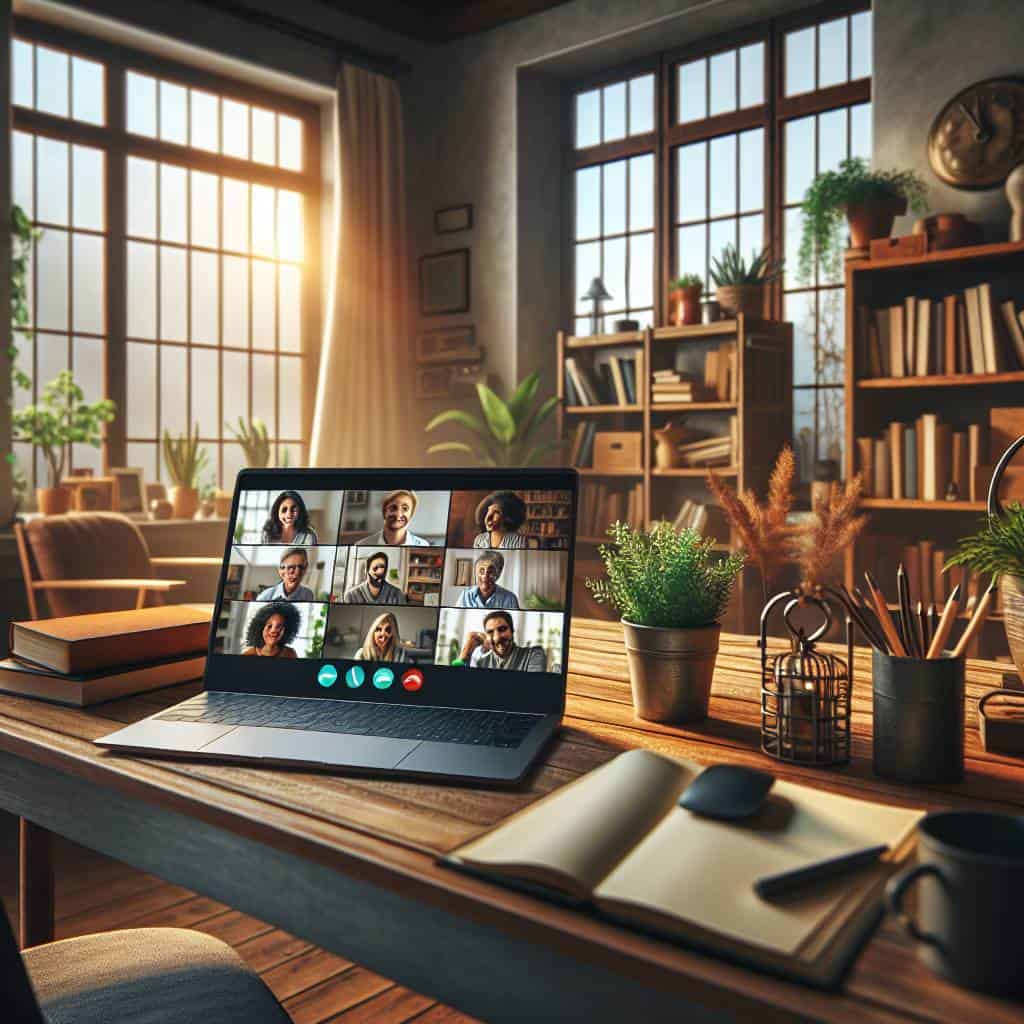
Navigating virtual meetings in Zoom, Google Meet, or Microsoft Teams feels like trying to connect human-to-human through a digital fog—necessary yet unnervingly distant.
The Virtual Meeting Gauntlet: My Final Take
Navigating the digital meeting circus has been a ride—one that’s been both liberating and bizarrely constricting. Google Meet might have been my saving grace on more than one occasion, a lifeline in the chaos of pandemic-induced isolation. Yet, let’s face it, when you’re trading a comfortable office chair for the couch, and a coffee-fueled chat for a pixelated grin, something gets lost in translation. It’s like trying to connect dots that just keep moving. But here’s the silver lining: these platforms, for all their quirks, have kept the professional wheels turning when the world came to a standstill.
Still, I’m not blind to the irony. The very tools designed to connect us also highlight how disjointed our interactions can become. Microsoft Teams, Zoom, and the rest of the virtual gang are here to stay, whether we’re ready or not. And maybe that’s not such a bad thing. It’s forced us to rethink communication, to strip it down to its core essentials. So, while I might miss a good old-fashioned water cooler chat, I’ve found a new appreciation for the straightforward, no-nonsense exchanges that these platforms demand. They’ve made us sharper, more concise, and—dare I say it—more authentic. At least, that’s the hope.