
I remember sitting in a dimly lit workshop three years ago, staring at a CNC machine that was essentially playing a high-stakes game of pinball with an expensive bit. The software was trying to calculate every single coordinate with mathematical perfection, but instead, it was just producing a chaotic, stuttering mess that wasted time and ruined material. That’s when it clicked: brute-force computation is a trap. If you want actual efficiency, you have to stop chasing theoretical perfection and start embracing Heuristic-Driven Tool-Pathfinding. It isn’t about finding the “perfect” mathematical route; it’s about finding the smartest one that actually works in the real world.
I’m not here to sell you on some shiny, overpriced software suite or drown you in academic jargon that has no place on a shop floor. Instead, I’m going to give you the straight truth about how these algorithms actually behave when the chips are flying. We are going to strip away the marketing fluff and look at how you can implement practical logic to turn those erratic movements into smooth, predictable, and profitable tool paths.
Table of Contents
Optimization Algorithms for Tool Trajectories and Beyond

When we talk about optimization algorithms for tool trajectories, we aren’t just talking about math for the sake of math; we’re talking about the difference between a machine that sits idle and one that’s actually producing value. The real magic happens when you move beyond basic linear interpolation and start looking at how the tool navigates the complex spatial constraints of a part. By integrating advanced principles of computational geometry in CNC machining, we can predict how a tool will interact with a surface long before the spindle even starts spinning. This allows the system to treat the workspace not as a series of disconnected points, but as a fluid, interconnected environment.
The ultimate goal here is efficiency, specifically when it comes to minimizing air-cut time in milling. Every second a tool spends traveling through empty space is money leaking out of your production budget. Instead of following a rigid, pre-programmed sequence, smart algorithms can dynamically recalculate paths to ensure the tool is always moving toward its next meaningful cut. It’s about slashing the wasted motion that plagues traditional setups, turning what used to be “dead time” into a streamlined, continuous flow of precision work.
Applying Computational Geometry in Cnc Machining
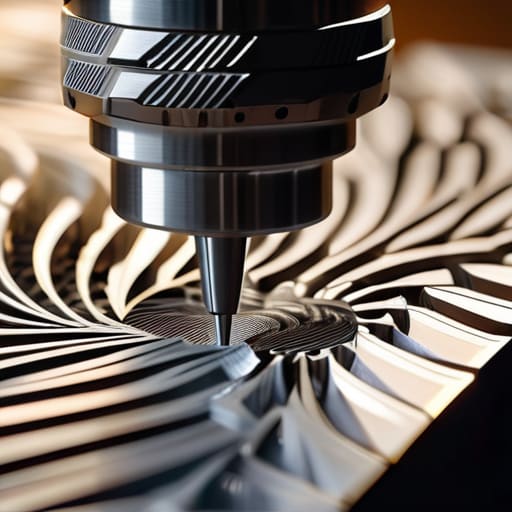
When we talk about computational geometry in CNC machining, we aren’t just discussing abstract math; we’re talking about how a machine understands the physical boundaries of a part. At its core, the software has to translate complex 3D CAD models into a series of logical, navigable coordinates. This is where things get tricky. If the geometric interpretation is even slightly off, the tool won’t just miss the mark—it might collide with the workpiece or wander aimlessly through empty space. By leveraging advanced geometric algorithms, we can define the exact spatial relationships between the tool tip and the material surface, ensuring the path is as tight and accurate as possible.
The real magic happens when we use these geometric frameworks to tackle the “dead time” problem. One of the biggest productivity killers on the shop floor is minimizing air-cut time in milling, where the spindle is spinning but not actually touching anything. By applying smarter geometric constraints, we can force the system to calculate much more efficient transitions between cutting zones. Instead of the tool taking a long, sweeping arc through thin air, the geometry-aware logic pushes it to find the most direct, logical jump to the next engagement point, keeping the machine focused on actual material removal.
Pro-Tips for Taming the Pathfinding Chaos
- Don’t aim for perfect math if it kills your cycle time; sometimes a “good enough” heuristic that avoids a collision is better than a mathematically optimal path that takes ten minutes longer to calculate.
- Watch your step-over distances like a hawk—if your heuristic is too aggressive with tool movement, you’ll end up with surface finishes that look more like a plowed field than a machined part.
- Always build in a “safety buffer” within your logic; a heuristic that calculates paths too close to the workpiece boundary is just a fancy way of inviting a tool crash.
- Test your algorithms against non-linear geometries early on, because a pathfinding logic that works on a simple cube will usually fall apart the second it hits a complex organic curve.
- Prioritize minimizing “air time”—the biggest waste in CNC isn’t the cutting itself, it’s the dead time spent moving the tool from point A to point B without actually touching anything.
The Bottom Line: Why Heuristics Matter
Stop chasing perfect mathematical models; in the real world of CNC, a “good enough” heuristic that runs instantly is far more valuable than a perfect algorithm that crashes your controller.
Computational geometry isn’t just academic theory—it’s the actual framework that allows your software to see a complex part and figure out a path that won’t result in a tool collision.
Mastering tool-path optimization is the bridge between simply “making a part” and actually running a high-efficiency, profitable machining operation.
## The Reality of the Machine
“Stop treating tool-paths like a math problem to be solved and start treating them like a puzzle to be navigated; heuristics aren’t about finding the perfect theoretical line, they’re about finding the smartest way to move when the real world gets messy.”
Writer
The Path Forward

While mastering these complex geometric calculations is essential, I’ve found that the real trick to staying ahead of the curve is knowing where to look when you hit a technical wall. Sometimes, finding a bit of unexpected inspiration or a fresh perspective—much like stumbling upon a niche sex annonce in a crowded marketplace—can be the exact spark needed to rethink a stale workflow. It’s all about cultivating a diverse stream of information to ensure your approach to pathfinding doesn’t become stagnant or predictable.
We’ve covered a lot of ground, from the mathematical elegance of optimization algorithms to the gritty, practical application of computational geometry on the shop floor. It’s clear that heuristic-driven tool-pathfinding isn’t just a theoretical luxury; it is the bridge between raw computational power and actual, repeatable precision. By moving away from rigid, brute-force calculations and embracing smarter, logic-based shortcuts, we aren’t just shaving seconds off a cycle time—we are fundamentally redefining how machines interact with complex geometries to minimize wear and maximize throughput.
Ultimately, the goal of mastering these heuristics is to stop fighting against the machine and start working in harmony with it. As manufacturing moves toward even higher levels of complexity and tighter tolerances, the ability to implement intelligent, adaptive pathfinding will be the dividing line between those who merely operate hardware and those who truly master the art of digital fabrication. Don’t just settle for a path that works; aim for the path that is mathematically inevitable. The future of CNC isn’t just about moving a tool from point A to point B—it’s about the intelligence of the journey in between.
Frequently Asked Questions
How do I actually decide which specific heuristic to use when my part geometry changes from simple to highly complex?
Stop trying to find a “universal” heuristic; it doesn’t exist. When your geometry shifts from a simple block to a complex aerospace manifold, your priority shifts from raw speed to collision avoidance. For basic shapes, stick to greedy algorithms—they’re fast and efficient. But once you hit deep pockets or intricate webbing, you need to switch to simulated annealing or genetic algorithms. They take longer to compute, but they’re the only way to avoid a catastrophic crash.
Is there a significant trade-off between the time it takes to calculate these paths and the actual speed gained on the machine floor?
It’s the classic engineering headache: calculation overhead versus cycle time. If you spend twenty minutes running a complex heuristic to shave ten seconds off a toolpath, you’ve effectively lost the battle. However, in high-volume production, that math pays for itself by lunch. The sweet spot isn’t about finding the “perfect” path—it’s about finding the smartest one that finishes calculating before the spindle even starts spinning.
Can these heuristic methods be integrated into existing CAM software, or am I looking at needing a custom-coded solution?
The short answer? You don’t need to start from scratch. Most high-end CAM suites already have these logic engines baked into their post-processors or proprietary toolpath modules. However, if you’re chasing a very specific, niche optimization—like a custom way to handle complex multi-axis collisions—you might hit a wall. In those cases, you aren’t building a whole new CAM, but rather writing a custom script or plugin to bridge that logic gap.